




Becoming Bruce Lee
Seattle Children’s Theatre’s 'Young Dragon' traces how five formative years in Seattle shaped a global icon and reminds young audiences that excellence is built, not born.
 By Sarah Stackhouse February 26, 2026
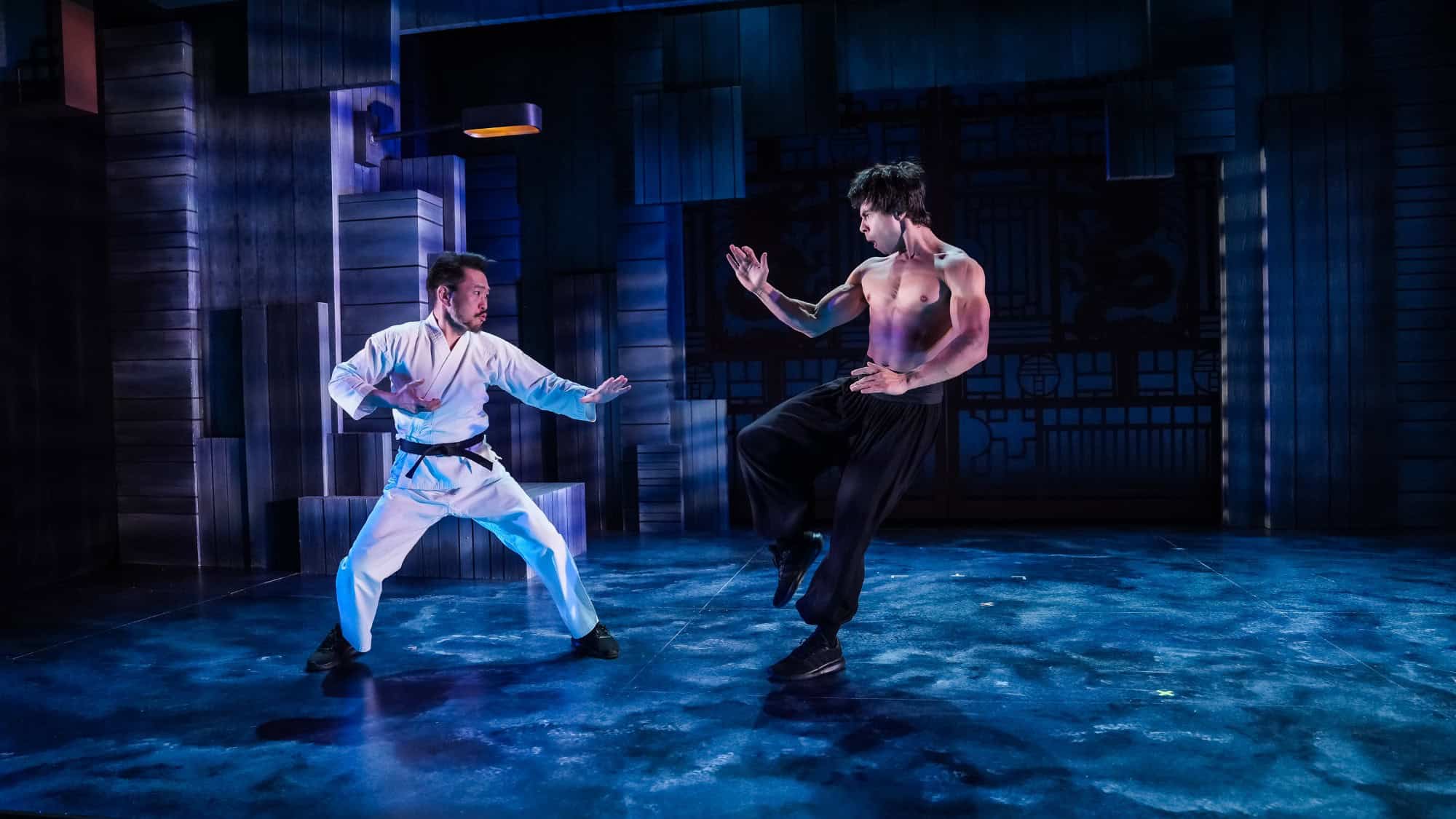
The dragon first appears as a flicker.
Bruce Lee is not yet the untouchable icon of posters and slow-motion flying kicks. He’s a teenager with a temper, wrestling with a little hot dragon inside him—the fire that flares before he knows what to do with it. It’s a feeling many kids (and adults) in the audience will recognize immediately.
That’s one of the many triumphs of Young Dragon: A Bruce Lee Story, the world premiere written by Seattle playwright Keiko Green, who has also written for Hulu’s Interior Chinatown, and directed by Jess McLeod. Commissioned by Seattle Children’s Theatre and the John F. Kennedy Center for the Performing Arts, the production focuses not on Lee’s Hollywood stardom but on the five years he spent in Seattle from 1959 to 1964—studying philosophy at the University of Washington, teaching dance classes, performing at the 1962 World’s Fair, opening two kung-fu schools, falling in love with his wife Linda Emery, and figuring out who he was.
The focus on Bruce’s Seattle years came directly from the commission. When the project began, Green was directed to Be Water, My Friend, a book by Bruce Lee’s daughter, Shannon Lee, as source material. “Her book is more like philosophy than it is biography,” Green says. “So the big question was, how do you make a philosophy story meaningful and fun for kids?” In early conversations, Green asked Shannon what she hoped young audiences would take away. Shannon told her she didn’t want the play to feel like a documentary. “I want it to feel like you have a voice,” she told her. She also emphasized her father’s curiosity and complexity, and that kids should walk away understanding they don’t have to put themselves in a single box.
The play opens with Bruce’s debilitating back injury—an experience that would come years after his time in Seattle and force him to rethink both his body and his philosophy. Michelangelo Hyeon, who plays Bruce, could relate. He took on the role shortly after suffering his own severe back injury.
“It means the world to me,” Hyeon says of playing Bruce. “It’s probably the greatest honor of my entire life to get to honor the legacy of one of the greatest people who ever lived.”
In preparation, he trained at the Inosanto Academy of Martial Arts under Dan Inosanto, one of Bruce Lee’s former students. Green says the goal was never to present Bruce as untouchable. “By telling the part of the story where he is flawed and still figuring it out,” she says, “we get to show that everyone is capable of their own version of excellence.”
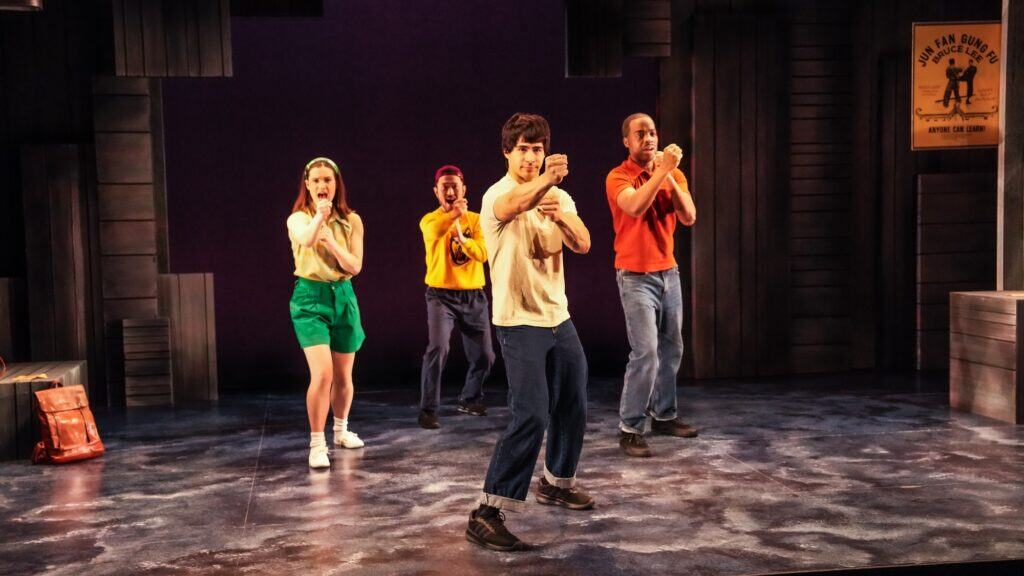
Bruce struggles in the U.S. as a Chinese immigrant navigating racism and confusion about his identity. When he returns to Hong Kong for a visit, he feels out of place there, too. The play does not smooth those tensions or resolve them neatly. It lets them sit. For kids in the audience—especially those who have ever felt caught between cultures or identities—that struggle will be familiar.
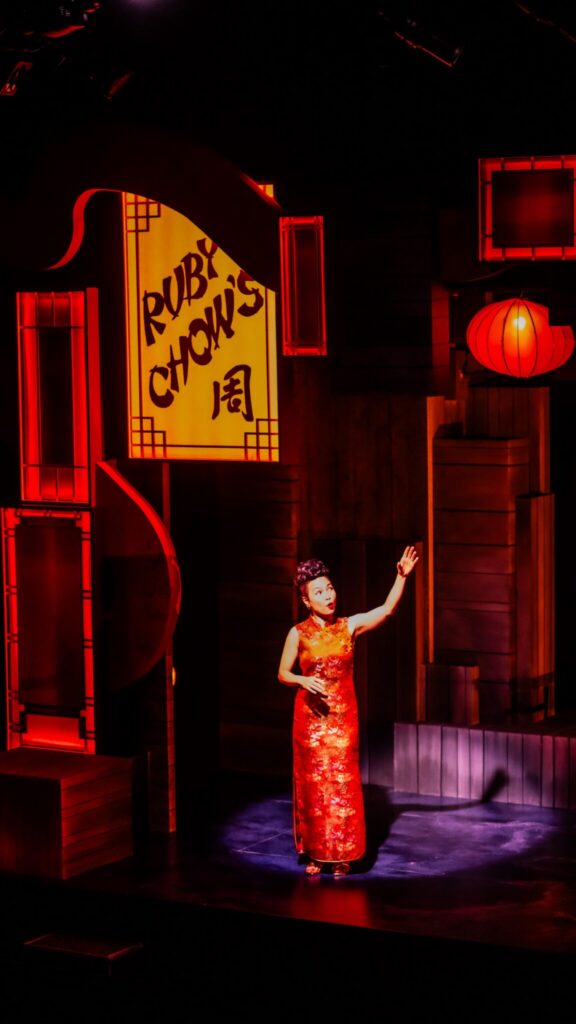
One of its most compelling characters is Ruby Chow, the formidable Seattle restaurateur who gave Bruce a room and a job when he first arrived at 19. Played with authority and depth by Khanh Doan, Ruby is both savvy and strategic. She’s a Chinese American woman who knows how to charm powerful white patrons while also pushing back against racism and advocating for her community. She has a clear affection for Bruce and identifies with his determination. She acts as a mentor, giving him opportunity while also teaching him how to move within the system without being swallowed by it.
The tension over who gets to teach kung fu is also central. Bruce’s embrace of students of all races and genders defies tradition. Having studied Wing Chun in Hong Kong, he begins developing Jeet Kune Do in the U.S.—a hybrid form influenced by boxing and other disciplines. He believed Chinese culture had a lot to offer the Western world and refused to restrict access.
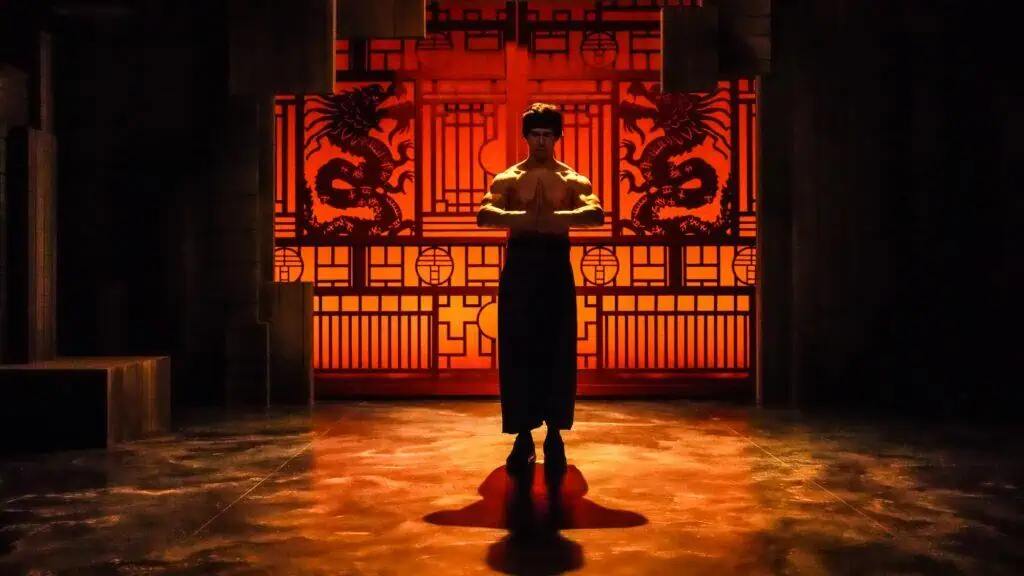
Water becomes the play’s governing metaphor. A twirly, ribbon-like banner arcs above the stage like a cresting wave or the curve of a dragon’s back, shifting from red to blue as Bruce wrestles with his temper and learns control. He studies his reflection, absorbing the lesson he would later immortalize: “Be like water.” Fluid, adaptive, soft and strong at once. In the final scene, an icy blue dragon meets him. It does not attack. It moves with him. They circle and mirror each other. The hot, unruly fire from earlier in the play cools into something steadier. What once threatened to spill over now moves with intention.
Seattle’s reputation for grit feels baked into the show. Anyone who lives here has fielded questions about the gray, rainy skies. And for someone young and driven, it can be a hard place to find footing, so it makes sense that this isn’t a story of instant genius but of practice, self-discipline, failure, and resilience. Green leans into the local details—Seafair jokes, UW references, and nods to Dick’s Drive-In that land with a hometown audience.
Sitting in the theater, you feel it. The story belongs here.
The show was originally slated to transfer to the Kennedy Center after its Seattle run, but Seattle Children’s Theatre opted not to continue the production there following recent leadership changes at the Kennedy Center under the Trump administration that prompted national backlash and artist withdrawals. While the decision means a broader audience will not see the play, it shows the theatre’s commitment to standing by its values and its artistic community.
Just last week, the U.S. Postal Service released a Bruce Lee Forever stamp. At the same time, Seattle is coming off a Super Bowl win that drew more than 120 million viewers worldwide, with halftime messaging about love, unity, and the embrace of immigrants and diverse cultures, and a Seahawks victory parade that brought an estimated one million fans into our streets to celebrate. The past few weeks in Seattle have been defined by civic pride and neighbors showing up for one another. Bruce Lee’s story—an immigrant who made Seattle part of his foundation while challenging cultural boundaries—is especially relevant right now.
By the final bow, Bruce Lee has not yet become the Bruce Lee many of us think of. He is still in motion. The global fame comes later. The work happened in Seattle.
Young Dragon: A Bruce Lee Story runs through March 29 at Seattle Children’s Theatre. Tickets are available here.
Follow Us
AANHPI Month: Where to Celebrate, Eat, and Learn Around Seattle
From festivals and museum exhibits to food tours and historic neighborhoods, here are a few ways to mark the month across the region.
Asian American, Native Hawaiian, and Pacific Islander Heritage Month—known as AANHPI Month—is observed in the U.S. each May. It began as a weeklong observance in 1978 and expanded to the full month in 1992. Asian, Hawaiian, and Pacific Islander communities in the United States extend back much further, including to the late 16th century, when…

Black Panther Park in Skyway Becomes First Black Panther Park in the World
The new community garden honors the Black Panther Party’s legacy of food justice and the Skyway neighbors who helped bring it to life.
On a sunny Sunday earlier this month, at the corner of 75th Avenue and Renton Avenue South, the community gathered for the opening of Skyway’s Black Panther Park. Inspired by the Black Panther’s Free Breakfast for School Children program that compelled the federal government to provide breakfast in schools, Black Panther Park is a community…

Rearview Mirror: A Family Coming Apart, SIFF, and My First Fashion Show
Things I did, saw, ate, learned, or read in the past week (or so).
The Family House A house can hold a lot, and Seattle Rep’s Appropriate knows that. Branden Jacobs-Jenkins’ Tony-winning play, directed here by Timothy McCuen Piggee, drops the Lafayette siblings into their late father’s hoarded, falling-apart Arkansas plantation home for an estate sale, and lets the whole thing crack open from there. The sibling dynamics are…
Studio Sessions: Raili Jänese
The Kirkland painter brings a playful eye to daily life and the little rituals of being human.
Artist Raili Jänese pays close attention to the small stuff. It might be a goose on the move, a rabbit in the yard, or a person lost in the rituals of coffee or cooking. The Estonian-born artist, now based in Kirkland, makes colorful acrylic works that turn everyday behavior—human and animal alike—into something funny and…