




Adapt or Die: How Local Media are Shifting Shape Again
Knute Berger reflects on the latest disruptions to our local media landscape
By Knute Berger March 8, 2016
This article originally appeared in the April 2016 issue of Seattle magazine.
Seattle media is being significantly reshaped, undergoing the impacts of technological disruption every bit as significant as climate change. How people get, digest and disseminate “news” has changed globally, and is being felt locally. Established local media are often having to respond to bruising changes, whether they like it or not.
Examples abound from the past few months. Public radio station KPLU is being sold to competing public radio station KUOW. The sale threatened to close KPLU’s news operation. KPLU’s fans vociferously objected and now have a chance to buy the station themselves, if they can raise the $7 million to do so. The shock of the sudden transaction and impending closure alarmed the public, as people wondered “Why?”
On the heels of that, Crosscut—the nonprofit online Seattle news site—merged with Seattle’s public television station KCTS, which is in the midst of rebranding as Cascade Public Media. That deal came soon after KCTS layoffs last spring that saw many members of the station’s production staff leave. This merger didn’t result in a newsroom closure for Crosscut. Instead, its resources were boosted. Still, the deal raised questions as to why the two media nonprofits would join forces.
In the meantime, there were major changes for a couple of print standbys. Seattle Weekly significantly cut its editorial staff, which can be counted almost on one hand now. When I was editor of that newspaper back in the early ’00s, it took at least four hands to count the creative staff. The Weekly is now part of a community newspaper chain and a shadow of its former self.
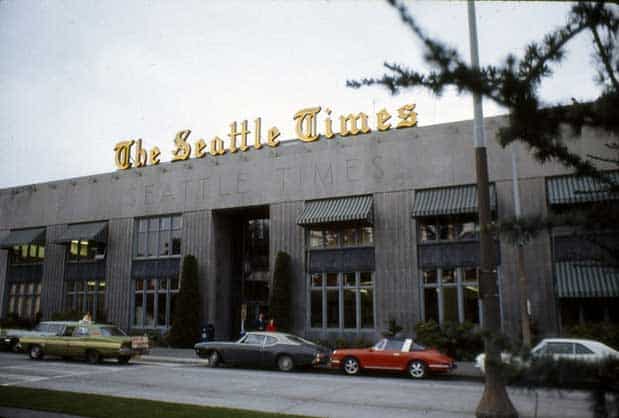
At the end of the year, the Incredible Shrinking Seattle Times—once the monopolistic giant of Seattle print publishing—took another hit, downsizing by 15 staffers—14 of whom took voluntary buyouts. The Times has sold much of its real estate, pulled in its horns and sits uneasily in South Lake Union: Its old landmark headquarters has devolved into an abode for squatters and vandals while it awaits redevelopment.
The symbolism of folks setting fires in the old Times building is not lost on media members who have seen growth, stability and power wane, and who feel that the reliable old media have been torched by the Internet, social media including Twitter and Reddit, texting, mobile devices and blogging.
The imperative is adapt or die. I feel somewhat lucky in my career because I chose a path of insecurity from the beginning by focusing on startup publications. We worked out of trailers, sat staffers on cardboard boxes and had desks made from old doors. This was before the dot-com boom and stock options. But my startups—newspapers, magazines, even an almanac—had familiar formulas. We launched magazines and newspapers with predictable business models. The challenge was largely in the content or finding a new niche, not the form or formula.
Public radio today is challenged by the fact that you no longer need KUOW or KPLU to get NPR or other public radio content. You can get podcasts on your phone from anywhere. People can tune radio out. Consolidation of resources, and in the case of KUOW, increasing its reach with KPLU’s equipment, helps it mitigate some of the changes and challenges it faces.
KCTS, too, wants to broaden the platforms available to it under a public media umbrella. It has a large television audience, but boosting its commitment to online reporting is a plus. In the words of station CEO Rob Dunlop, the merger with Crosscut “helps us strengthen our journalism chops.”
The Times is increasingly becoming leaner, meaner and more focused on being a newspaper that’s stronger online and not reliant on newsprint. The Weekly has ditched trying to have comprehensive entertainment listings in its pages—those are better accessed online—and is using its precious print space for more stories, important when you have fewer pages. Both are looking for more sustainable economic models.
Still, adaptation doesn’t mean there is no net loss for those who want news. Does Seattle really need one less radio newsroom? Does a smaller Times editorial staff serve us well? Is the online Seattle Post-Intelligencer a better media product than the old print P-I?
One publication that has impressed me with its ability to adapt—and increase its clout—is The Stranger. Its tongue-in-cheek slogan, “Seattle’s Only Newspaper,” is scarily close to the truth these days. It has been an upstart for a quarter century, but has adapted with its Slog blog and has improved its content (it won a Pulitzer in 2012).
But even The Stranger, known for its criticism of the Blethen-family-owned Times, has concerns about what’s happening media-wise in this town. We are losing something with the twilight of the old media, like real journalism. Publisher Tim Keck tells me the “Seattle Times, a severely damaged publication, does more for our city in a day than Yelp and Craigslist (to pick up a couple of brands that have been around for a while) have done in their lifetimes.” In other words, surviving is one thing, but operating with a real news commitment and resources is something else. Seattle needs that more than ever, and not every new media iteration is going to fill that gap. “Cities are humans’ greatest invention. Cities don’t work without good local media,” says Keck.
Collectively, the local media are crowdsourcing a solution. New partnerships, experiments, cutbacks, all are the order of the day, but as yet there is no single answer to how to improve and grow substantive local news in the new media environment. Change, says Keck, is not just a reality, but has to become part of a media entity’s brand—the expected thing, not the resisted one. “The stakes are high, and local media has to figure it out,” he says.
We’re all startups now, like it or not.
Follow Us

Photo Essay: Ferry Therapy
Words and photographs by Anna Starr.
Riding the ferry is my favorite Seattle pastime. At any given time on a Washington State Ferry you will find a group of tourists with too many suitcases, someone in work clothes peacefully napping, a jigsaw puzzle diligently being completed, lovers having a Titanic-esque moment on a balcony (fun fact: those balconies are called pickleforks),…
AANHPI Month: Where to Celebrate, Eat, and Learn Around Seattle
From festivals and museum exhibits to food tours and historic neighborhoods, here are a few ways to mark the month across the region.
Asian American, Native Hawaiian, and Pacific Islander Heritage Month—known as AANHPI Month—is observed in the U.S. each May. It began as a weeklong observance in 1978 and expanded to the full month in 1992. Asian, Hawaiian, and Pacific Islander communities in the United States extend back much further, including to the late 16th century, when…

Black Panther Park in Skyway Becomes First Black Panther Park in the World
The new community garden honors the Black Panther Party’s legacy of food justice and the Skyway neighbors who helped bring it to life.
On a sunny Sunday earlier this month, at the corner of 75th Avenue and Renton Avenue South, the community gathered for the opening of Skyway’s Black Panther Park. Inspired by the Black Panther’s Free Breakfast for School Children program that compelled the federal government to provide breakfast in schools, Black Panther Park is a community…

Rearview Mirror: A Family Coming Apart, SIFF, and My First Fashion Show
Things I did, saw, ate, learned, or read in the past week (or so).
The Family House A house can hold a lot, and Seattle Rep’s Appropriate knows that. Branden Jacobs-Jenkins’ Tony-winning play, directed here by Timothy McCuen Piggee, drops the Lafayette siblings into their late father’s hoarded, falling-apart Arkansas plantation home for an estate sale, and lets the whole thing crack open from there. The sibling dynamics are…