




‘Angels in America’ to Feature Mark Mitchell’s Costume Design, No Feathers Allowed
Seattle artist Mark Mitchell creates garments fit for an angel—and the dearly departed
By Brangien Davis August 14, 2014
This article originally appeared in the August 2014 issue of Seattle magazine.
The messenger angel in Tony Kushner’s play Angels in America makes a famously big entrance when she first appears—crashing through the roof of an apartment building to convey her prophecy to a gay man struggling with AIDS in 1980s Manhattan. In the original 1993 Broadway production, which won a Tony Award for Best Play and a Pulitzer Prize, the angel’s wings are almost bat-like, sharply angled like chevrons. In HBO’s 2003 miniseries version, the wings are more swanlike, arches that sweep to a 12-foot span. Now that Seattle’s Intiman Theatre Festival has chosen to produce the epic play this summer (the two parts, Millennium Approaches and Perestroika, clock in at three and a half hours each), the red-carpet question is, what will the angel wear?
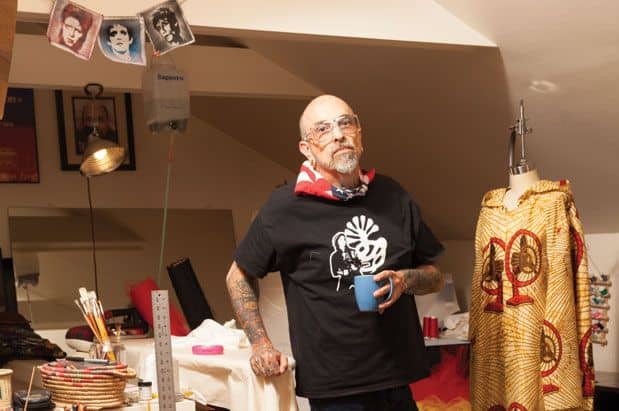
Back in June, Seattle artist Mark Mitchell, the costume designer on the Intiman production, hadn’t yet decided how he would create the angel’s appendages, but he was certain about one thing: “No feathers!” Adorned in face tattoos, gauge earrings and ’80s-retro glasses, 52-year-old Mitchell explains, “You can’t do feathers without killing a bunch of very large birds.” Sitting in the living room of the 1905 pagoda-style Capitol Hill house he shares with his longtime partner Kurt B. Reighley (KEXP-FM’s DJ El Toro), he adds, “Plus I’ve never seen a pair of feathered wings I’ve liked.” Mitchell pulls his rescue Boston terrier Glouchester in closer on a couch he has upholstered in a loud daisy-pattern fabric. He admits, more than the other costumes in the play, he finds the wings intimidating. “They’re the scariest,” he says, “because I’ve never done them before.”
See Mark Mitchell’s costume design in Angels in America: 8/12–9/21. Cornish Playhouse at Seattle Center, 201 Mercer St.; 206.315.5838; intiman.org. For updates on the Burial project, visit markmitchellburial.com.
He may not have created wings before, but since arriving in Seattle in 1984, Mitchell has crafted all manner of heavenly couture, for burlesque stars, contemporary dancers, drag queens, brides, actors, bon vivants—and lately, the opposite. Mitchell made a splash on the avant-garde art scene last September with a solo show at the Frye Art Museum, Mark Mitchell: Burial. It featured nine exquisitely crafted garments he called “ensembles to clothe the dead.” The designer used his decades of experience in fashion and costuming to present a stunning collection of white silk dresses, tunics and loose pants—layered, embroidered, buttoned and ruffled—with slippers that would never be walked in. On opening night the models laid on the floor, absolutely still, playing dead. It was breathtaking.
With the vestments he created something more than clothing, combining his painstaking craftsmanship and theatrical flair with an overarching philosophy. “Death is coming for us all,” he says with a smile, “and it’s nothing to fear.” Mitchell’s gallows humor is earned. He has been living with HIV for the last 21 years, and during the AIDS crisis, he saw friends die all around him. While he’s in generally good health now, he is well aware that long-term HIV patients are more likely to die of sudden cardiac arrest. Every day, he thinks, “Did I try to make an effort today? Or was I feeling sorry for myself?” Like so many whom death has gripped by the lapels, he feels an urgency to make his life meaningful. (Joking about the cost of HIV drugs, he says, “I’m very expensive to keep alive. I want to be worth it.”) Out of respect for those who passed, he says, “I feel a responsibility to work hard and not get stuck in a pit of despair.”
Mitchell knows the contour of that pit well—he crawled down into it for years after his diagnosis, numbing the pain with alcohol and hard drugs. He was going to die soon anyway, he figured, “So why the hell not!” But the longer he lived, the more it seemed like a good idea to stick around, especially after meeting Reighley, who Mitchell says “showed me I was worth living a real life.” When he turned 50, he made the conscious decision to close his party-boy era entirely, giving up “old thinking, old relationships and mourning for so long.” Now he suspects he was making the mental space for his Burial odyssey.
“I enjoy all of my commissions and collaborations,” Mitchell says, which currently include designing a touring wardrobe for Seattle hip-hop artist Tendai Maraire. “But doing my own personal work is what matters. It’s the truest to my vision.” He’s already mentally designing his second Burial collection, which he hopes to show in early 2016. In May, The New Foundation Seattle admitted him to its Artist Program, which helps finance exhibits by local artists at galleries outside of Seattle. His mission is clear: “I want to shorten the distance between people and death, so it’s not so scary,” he says. “That’s why my burial garments have so many buttons—so mourners can spend time with the body, so you aren’t so distanced from the process.”
But for the moment he’s focused on Angels, a play he says is important to him, perhaps especially given its message of perseverance in the face of tragedy. “I think people will see it again and be surprised at how prophetic it turned out to be,” he says. He also hopes younger people who didn’t witness the AIDS crisis will understand that the humor of the play is vital. Referring to a memorable scene, he says, “I feel like I wrestled with the angel of death, too, and I’m able to laugh about it now.” In his home studio, under pictures of David Bowie, Lou Reed and Iggy Pop—a personal sort of seraphim—he holds up a swath of fabric: off-white, vintage raw silk with a divine shimmer.
Follow Us
Photo Essay: Ferry Therapy
Words and photographs by Anna Starr.
Riding the ferry is my favorite Seattle pastime. At any given time on a Washington State Ferry you will find a group of tourists with too many suitcases, someone in work clothes peacefully napping, a jigsaw puzzle diligently being completed, lovers having a Titanic-esque moment on a balcony (fun fact: those balconies are called pickleforks),…
AANHPI Month: Where to Celebrate, Eat, and Learn Around Seattle
From festivals and museum exhibits to food tours and historic neighborhoods, here are a few ways to mark the month across the region.
Asian American, Native Hawaiian, and Pacific Islander Heritage Month—known as AANHPI Month—is observed in the U.S. each May. It began as a weeklong observance in 1978 and expanded to the full month in 1992. Asian, Hawaiian, and Pacific Islander communities in the United States extend back much further, including to the late 16th century, when…

Black Panther Park in Skyway Becomes First Black Panther Park in the World
The new community garden honors the Black Panther Party’s legacy of food justice and the Skyway neighbors who helped bring it to life.
On a sunny Sunday earlier this month, at the corner of 75th Avenue and Renton Avenue South, the community gathered for the opening of Skyway’s Black Panther Park. Inspired by the Black Panther’s Free Breakfast for School Children program that compelled the federal government to provide breakfast in schools, Black Panther Park is a community…
Rearview Mirror: A Family Coming Apart, SIFF, and My First Fashion Show
Things I did, saw, ate, learned, or read in the past week (or so).
The Family House A house can hold a lot, and Seattle Rep’s Appropriate knows that. Branden Jacobs-Jenkins’ Tony-winning play, directed here by Timothy McCuen Piggee, drops the Lafayette siblings into their late father’s hoarded, falling-apart Arkansas plantation home for an estate sale, and lets the whole thing crack open from there. The sibling dynamics are…