




Woody Sez: Guthrie’s Still Talkin’, Even Today
Seattle Repertory's musical portrait of Woody Guthrie, 'Woody Sez', rings true for our times, too
By Gwendolyn Elliott January 12, 2017
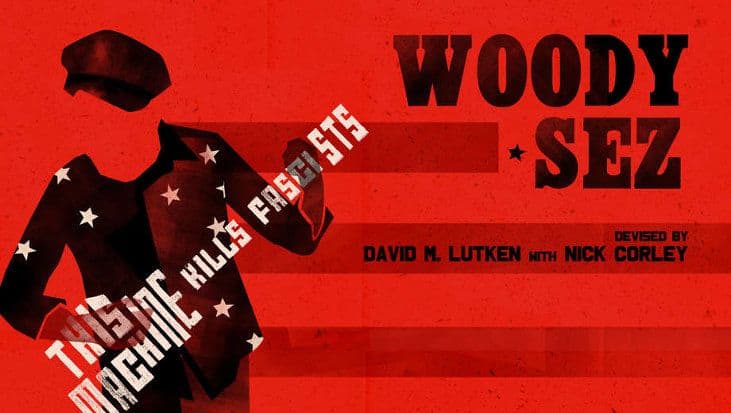
Three quarters of a century before Facebook and Twitter, Woody Guthrie was writing and singing songs about the complex issues we tweet incessantly about today: big banks, corporations, immigrants, the working class, greedy politicians, war. In David Lutken’s Woody Sez, the music-filled portrait of the life, times and songs of America’s folk-singing hero, Lutken, who wrote the script (with Nick Corley) and plays Guthrie, offers poignant commentary on the social media of the time—folk music—along with many subjects still relevant today.
During the Dustbowl and the Great Depression—Guthrie’s era—the best social currency was music: hootenannies and campfire jams, a way to forget the difficult hardships of life at the time. This we see rendered intimately on the Bagley stage though the production’s small, multi-talented cast—comprised of Lutken, Darcie Deavile, Helen Jean Russell and David Finch, all in a variety of roles—a scattering of sparse, mobile props, and a backdrop of a few iconic photos of Guthrie and the dust-caked Oklahoma prairie.
Lutken shines as the hardscrabble, hard travelin’ Guthrie, as the play loosely follows the songwriter’s life from boyhood to his final years in a New York city hospital, suffering from Huntington’s disease. Scenes and vignettes are fluid, woven together through rousing song, mostly adaptations and medleys of Guthrie’s famous folk anthems like “Pastures of Plenty” and “This Land Is Your Land,” along with other traditionals in the public domain.
The rollicking soundtrack and the instrumentation is impressive, with at least 11 acoustic string instruments, including a banjo, guitars of various sizes including a dobro, a handful of fiddles, the upright bass, an Appalachian dulcimer and an autoharp, all of which are played by rotating configurations of the cast, who we learn can not only act, sing and dance, but play, too. The authenticity this provides is noteworthy: there’s nothing canned or lip-synced about Woody Sez, which feels far more improvised, good-time campfire jam session than click track or timed to cue.
For all the rousing, familiar melodies (including last night’s encore of the official Washington state folk song, “Roll on Columbia,” which needed little prompting from Lutken to encourage a hearty audience sing along), the feeling that Guthrie’s life was strung together by a series of accidents, luck, misfortune, idealism, risk and happenstance is perhaps the culminating take away: expressed with tenderness and humor, we learn about a man like so many others—like me, you, them—and yet, having produced the so much of the American folk songbook, so different.
Woody Sez is a touching portrait of unity and togetherness, but also of the small seeds that sometimes sow revolution. Via Lutken’s portrayal, Guthrie came to understand the difference between “wanting something to change” and “wanting to change it” meant picking up the guitar and singing, his version of social media.
“This machine kills fascists, huh?” Guthrie is asked, late in the play, about the famous words scrawled on his guitar.
Today as then, his reply still rings true. “Yes. But you have to play it!”
Woody Sez runs thorugh January 29 at Seattle Repertory Theater.
Read our interview with Guthrie author and local KEXP DJ Greg Vandy here: Who Will Sing Trump’s Folk Songs?
Follow Us

Photo Essay: Ferry Therapy
Words and photographs by Anna Starr.
Riding the ferry is my favorite Seattle pastime. At any given time on a Washington State Ferry you will find a group of tourists with too many suitcases, someone in work clothes peacefully napping, a jigsaw puzzle diligently being completed, lovers having a Titanic-esque moment on a balcony (fun fact: those balconies are called pickleforks),…

AANHPI Month: Where to Celebrate, Eat, and Learn Around Seattle
From festivals and museum exhibits to food tours and historic neighborhoods, here are a few ways to mark the month across the region.
Asian American, Native Hawaiian, and Pacific Islander Heritage Month—known as AANHPI Month—is observed in the U.S. each May. It began as a weeklong observance in 1978 and expanded to the full month in 1992. Asian, Hawaiian, and Pacific Islander communities in the United States extend back much further, including to the late 16th century, when…

Black Panther Park in Skyway Becomes First Black Panther Park in the World
The new community garden honors the Black Panther Party’s legacy of food justice and the Skyway neighbors who helped bring it to life.
On a sunny Sunday earlier this month, at the corner of 75th Avenue and Renton Avenue South, the community gathered for the opening of Skyway’s Black Panther Park. Inspired by the Black Panther’s Free Breakfast for School Children program that compelled the federal government to provide breakfast in schools, Black Panther Park is a community…

Rearview Mirror: A Family Coming Apart, SIFF, and My First Fashion Show
Things I did, saw, ate, learned, or read in the past week (or so).
The Family House A house can hold a lot, and Seattle Rep’s Appropriate knows that. Branden Jacobs-Jenkins’ Tony-winning play, directed here by Timothy McCuen Piggee, drops the Lafayette siblings into their late father’s hoarded, falling-apart Arkansas plantation home for an estate sale, and lets the whole thing crack open from there. The sibling dynamics are…