



Tacoma Art Museum Reckons With the Roots of One of its Biggest Collections
TAM’s latest show reconsiders the meaning of Western American art
 By Rachel Gallaher June 4, 2024
This article originally appeared in the July/August 2024 issue of Seattle magazine.
On the night of Nov. 3, 1885, a mob composed of hundreds of people marched through Tacoma, expelling members of the Chinese community from their homes, intimidating them (with weapons and threats) into leaving the city permanently, and then burning down the remaining houses — often with all of the victim’s possessions still inside.
The night of terror, which would spawn an expulsion process dubbed the “Tacoma Method,” included many prominent citizens, and was endorsed by Tacoma’s mayor at the time, Jacob Robert Weisbach. This shameful page in Northwest history is addressed in the recently opened Finding Home: The Chinese American West, one of four exhibitions recently opened at Tacoma Art Museum as part of an expansive, multi-year program reexamining the museum’s prominent Haub Family Collection of Western American Art.
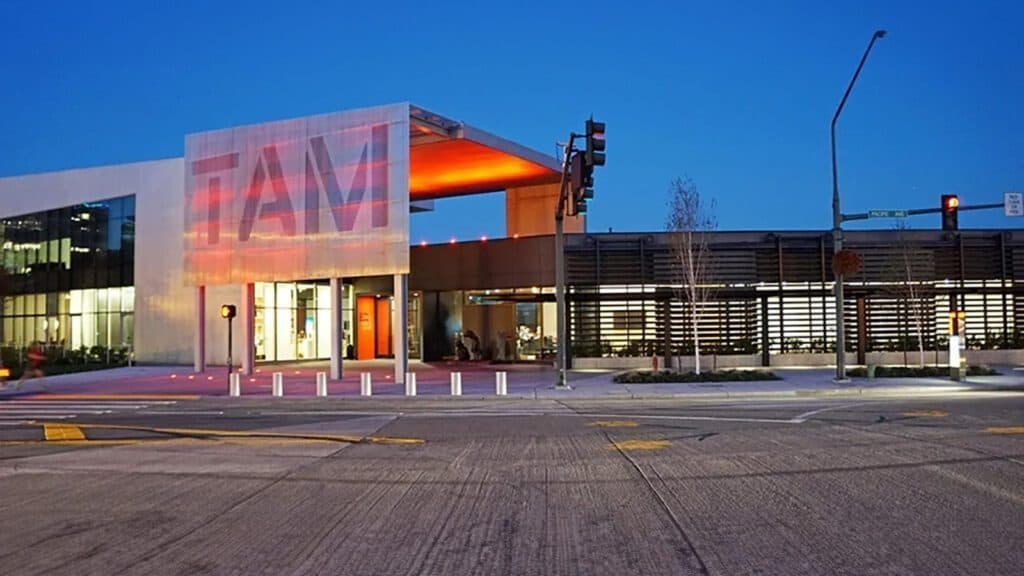
Imagined by four curators from different areas of the country, [re]Frame: Haub Family Collection of Western American Art provides a platform for artists whose work has long been left out of the Western art canon.
“The Haub Collection tells one side of the story,” says Seattle-based art advisor and curator Lele Barnett, who has worked with the Wing Luke Museum, Meta, Open Arts, Microsoft Art Collection, and Starbucks Art Program. (She is the only curator for the show that is based in the Northwest.) “I’m telling the Chinese-American story with my exhibition (Finding Home: The Chinese American West). In my discussions with the other curators, we talked about wanting to tell stories outside the colonizer narrative. One of my first questions for Faith (Brower, Haub curator of Western American Art at the Tacoma Art Museum) was, ‘Can we have contemporary artists tell these stories?’”
Brower’s answer was an unequivocal “yes.” For those unfamiliar with the Haub Collection, it is a trove of more than 295 pieces of Western American art, donated to TAM in 2012 (along with $20 million for a building expansion to hold the bequeathment) by Erivan and Helga Haub, a German couple who fell in love with the American West after visiting friends near Tacoma during their honeymoon in 1958.
Spanning multiple decades from the 1790s to today, the works comprising the collection are mired in stereotypical images of Native Americans, cowboys, desert landscapes, frontier living, and mountain men. The nearly 150 artists represented are predominantly white, and their idealized representations of life in a certain part of the country often ignore or erase the historical realities of violence, exploitation, and loss of land experienced by people of color in those areas.
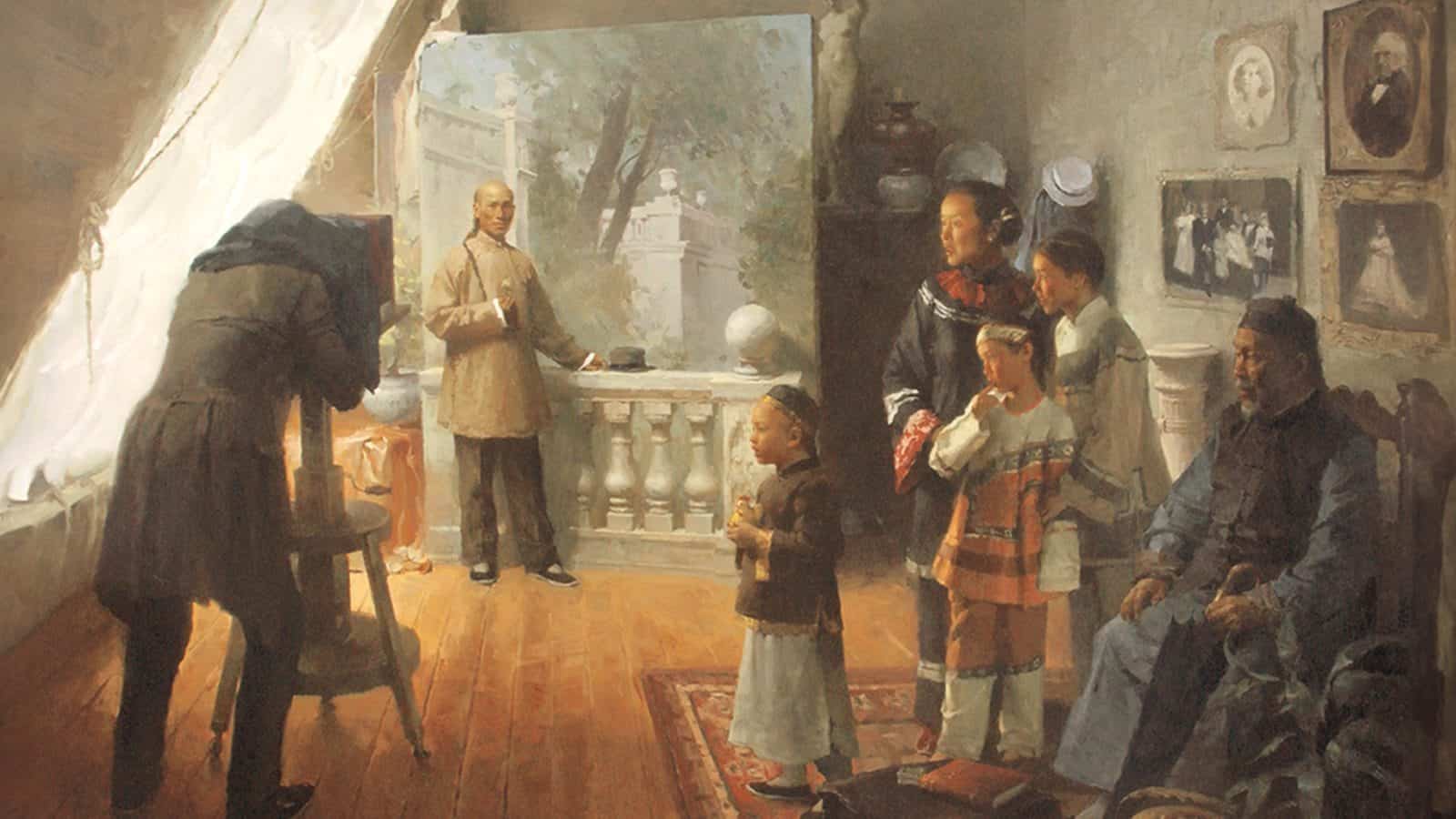
[Re]Frame: Haub Family Collection of Western American Art tries to address these discrepancies. For her part, Barnett reached out to Seattle-based artist Monyee Chau, who created a 65-foot, site-specific mural for the show. Barnett paired it with a large painted scroll by Zhi Lin that puts the viewer in a place to contend with Tacoma’s Chinese expulsion of 1885. Lin, a professor in the painting and drawing program at the University of Washington, has spent years researching the event.

“He has painted depictions of this history over and over again,” Barnett says. “At this point he knows all the names of all the Chinese people pushed out of town. Monyee created a giant mural on one of the walls that tells the story of the journey across the Pacific. They dive deep into history and are a great storyteller in their work.”
Works from the Haub collection will be displayed in each gallery to provide context for and dialogue with the new pieces. In Barnett’s exhibition, this includes Mian Situ’s 2006 painting, The Entrepreneur-San Francisco — 1890.
Three additional exhibitions — Nikesha Breeze’s Blackness is… the Refusal to be Reduced; Maymanah Farhat’s Nepantla: The Land is The Beloved; and Dr. Patricia Marroquin Norby’s The Abiqueños and The Artist — explore ideas around gender, race, homelands, the body, resilience, identity, and aesthetics. The four curators are giving space to 17 contemporary artists whose work is often excluded in the context of collections like the Haub. “The art of the American West is not static,” Brower says. “There are many artists creating work that will further our understanding and deepen our connections to this iconic region.”
Barnett’s hopes for the exhibition are personal. “A lot of it is about education, and telling these stories that we don’t often hear,” she says. “As a Chinese person growing up in the U.S., I felt lesser because my story wasn’t being told, so to me, it’s important to tell the lost stories of people of color who were so instrumental in building this country. I hope people who come start to think about their own identities and rethink the history they’ve been told in which so many people have been excluded.”

Follow Us
AANHPI Month: Where to Celebrate, Eat, and Learn Around Seattle
From festivals and museum exhibits to food tours and historic neighborhoods, here are a few ways to mark the month across the region.
Asian American, Native Hawaiian, and Pacific Islander Heritage Month—known as AANHPI Month—is observed in the U.S. each May. It began as a weeklong observance in 1978 and expanded to the full month in 1992. Asian, Hawaiian, and Pacific Islander communities in the United States extend back much further, including to the late 16th century, when…
Black Panther Park in Skyway Becomes First Black Panther Park in the World
The new community garden honors the Black Panther Party’s legacy of food justice and the Skyway neighbors who helped bring it to life.
On a sunny Sunday earlier this month, at the corner of 75th Avenue and Renton Avenue South, the community gathered for the opening of Skyway’s Black Panther Park. Inspired by the Black Panther’s Free Breakfast for School Children program that compelled the federal government to provide breakfast in schools, Black Panther Park is a community…
Rearview Mirror: A Family Coming Apart, SIFF, and My First Fashion Show
Things I did, saw, ate, learned, or read in the past week (or so).
The Family House A house can hold a lot, and Seattle Rep’s Appropriate knows that. Branden Jacobs-Jenkins’ Tony-winning play, directed here by Timothy McCuen Piggee, drops the Lafayette siblings into their late father’s hoarded, falling-apart Arkansas plantation home for an estate sale, and lets the whole thing crack open from there. The sibling dynamics are…
Studio Sessions: Raili Jänese
The Kirkland painter brings a playful eye to daily life and the little rituals of being human.
Artist Raili Jänese pays close attention to the small stuff. It might be a goose on the move, a rabbit in the yard, or a person lost in the rituals of coffee or cooking. The Estonian-born artist, now based in Kirkland, makes colorful acrylic works that turn everyday behavior—human and animal alike—into something funny and…